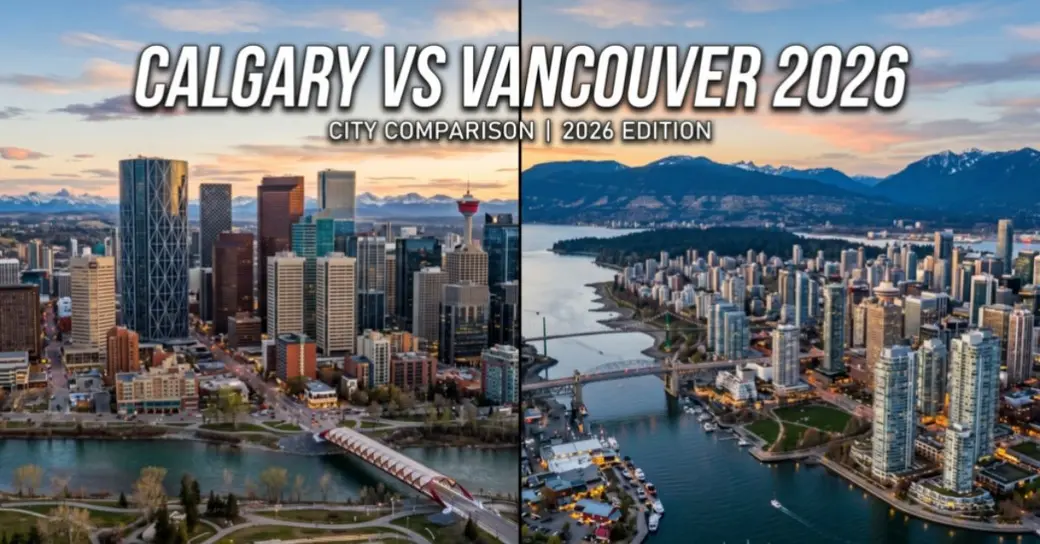
Calgary vs Vancouver: Which City Is Better for Families in 2026?

Dean Martin
Real Broker Calgary | 35 Years of Calgary Real Estate Experience
If you're weighing Calgary vs Vancouver in 2026, the housing numbers alone will stop you in your tracks. The gap between these two cities has grown into one of the most dramatic in Canada — and for families who want space, a yard, and a realistic path to ownership, it's reshaping where people choose to plant roots.
I've been selling Calgary real estate for 35 years, and I've never seen as many calls from Vancouver families as I do right now. They're not leaving because they stopped loving the mountains or the ocean. They're leaving because the math stopped working. Let me show you exactly what that math looks like in April 2026.
Table of Contents
- How Do Calgary and Vancouver Home Prices Compare in 2026?
- What's the Real Cost of Living Difference Between Calgary and Vancouver?
- Taxes: How Much More Does Vancouver Actually Cost After Tax?
- Calgary vs Vancouver for Families: Schools, Safety, and Space
- What Kind of Home Does Your Budget Buy in Each City?
- The Vancouver Lifestyle vs the Calgary Lifestyle: What Are You Actually Giving Up?
- Do You Need to Sell Your Vancouver Home First?
- Frequently Asked Questions
How Do Calgary and Vancouver Home Prices Compare in 2026?
In March 2026, the benchmark home price in Metro Vancouver was $1,104,300. The benchmark home price in Calgary was $565,600. That's a difference of $538,700 for a comparable home — and in the detached category, the gap is nearly $1.3 million.
These aren't cherry-picked numbers. Both figures come from official MLS® Home Price Index data — CREB for Calgary, Greater Vancouver REALTORS® for Vancouver. The benchmark price represents a typical home with typical attributes in each market, which makes it the most accurate apples-to-apples comparison available.
| Property Type | Calgary (March 2026) | Vancouver (March 2026) | Difference |
|---|---|---|---|
| Overall Benchmark | $565,600 | $1,104,300 | Vancouver costs $538,700 more |
| Detached Home | $703,250 (median) | $1,854,800 | Vancouver costs $1,151,550 more |
| Townhouse | $435,000 (median) | $1,047,100 | Vancouver costs $612,100 more |
| Apartment Condo | $305,000 (median) | $706,700 | Vancouver costs $401,700 more |
For a family that wants a detached home with a backyard — the kind of home where kids can actually play outside — Vancouver's benchmark price of $1,854,800 means a $370,000 down payment just to meet the 20% threshold and avoid CMHC insurance. In Calgary, that same 20% down on a $703,250 median detached home is $140,650. The difference in the down payment alone — $229,350 — is more than many families save in a decade.
And here's the direction each market is moving: Vancouver detached prices are down 8.2% year-over-year as of March 2026, while Calgary remains in seller's market territory at 2.9 months of supply. Calgary isn't cheap anymore, but it's stable, in demand, and still within reach for families who couldn't touch Vancouver's market even on two professional incomes.
To see how Calgary's housing market stacks up right now, take a look at my current Calgary house prices.
What's the Real Cost of Living Difference Between Calgary and Vancouver?
Housing gets all the attention, but it's not the whole story. When you add up rent, groceries, and taxes, Calgary runs about 10–11% cheaper than Vancouver. For a family of four, that adds up to real money every month — not rounding-error money.
Here's how the two cities compare across the categories that actually matter:
| Category | Calgary (2026) | Vancouver (2026) |
|---|---|---|
| 1-Bedroom Apartment Rent (central) | $1,800–$2,200/mo | $2,600–$3,000/mo |
| 2-Bedroom Apartment Rent (central) | $2,000–$2,500/mo | $2,800–$3,400/mo |
| 3-Bedroom House Rental | $2,800–$3,200/mo | $4,000–$5,000/mo |
| Provincial Sales Tax | None — Alberta has no PST | 7% PST on most purchases |
| Land Transfer Tax (provincial) | $0 — Alberta has none | Up to 3% of purchase price |
| Overall Cost of Living vs Calgary | — | ~10–11% higher |
The rental gap is where it really hits. A Vancouver family renting a three-bedroom house pays $1,200 to $1,800 more per month than they would in Calgary. Run that out five years and you're looking at $72,000 to $108,000 — gone. Before groceries. Before activities. Before anything.
The PST Nobody Talks About
Alberta has no provincial sales tax. BC charges 7% PST on most goods and services. If your family spends $4,000 a month on everyday purchases — groceries, clothes, kids' stuff, household items — that's $280 a month, or $3,360 a year, straight to the province. Over ten years, that's $33,600 that Calgary families just don't pay. It doesn't show up in any one transaction. It just quietly disappears in Vancouver, month after month.
What Does Your Paycheque Actually Buy?
The numbers put it plainly: to live the same lifestyle you have in Vancouver on $9,300 a month, you'd need about $7,700 in Calgary. That's a 17% efficiency gain on every dollar you earn. A $120,000 Calgary salary goes as far as roughly $140,000 in Vancouver. For most families I talk to, that difference is a mortgage payment. Sometimes it's the whole reason they call me.
For a full breakdown of what your money buys across Calgary's different communities, see my Calgary cost of living guide — it compares Calgary to both Vancouver and Toronto with current numbers.
Taxes: How Much More Does Vancouver Actually Cost After Tax?
The tax difference between Alberta and BC is one of the biggest financial advantages of moving to Calgary, and most people from Vancouver underestimate it until they see the numbers side by side.
No Provincial Sales Tax
Alberta is one of the only provinces in Canada with no provincial sales tax. BC charges 7% PST on most purchases. That's money off the top of everything you buy — clothing, furniture, electronics, kids' gear, restaurant meals. A family spending $50,000 a year on taxable goods and services pays roughly $3,500 more in BC just from PST. Every year.
Provincial Income Tax
Alberta's flat 10% provincial income tax rate is also lower than BC's graduated rates. On a $100,000 salary, you'll keep roughly $2,000 to $3,500 more per year in Alberta than in BC. At $150,000, that gap grows to $3,500 to $5,000. For two-income households — which most of my relocating families are — you can double those numbers.
| Salary | Approx. Annual Tax Saving in Calgary vs Vancouver |
|---|---|
| $100,000 | $2,000–$3,500/year |
| $150,000 | $3,500–$5,000/year |
| Two incomes at $100K each | $4,000–$7,000/year |
No Land Transfer Tax
BC charges a land transfer tax when you buy a home — 1% on the first $200,000, 2% on the amount between $200,000 and $2,000,000, and 3% above that. On a $1.1 million Vancouver home, that's roughly $19,000 due on closing day, on top of your down payment. Alberta has no provincial land transfer tax. Zero. That's money that stays in your pocket and goes toward your home instead.
Add it all up — no PST, lower income tax, no land transfer tax — and the tax advantage of living in Calgary over Vancouver is $5,000 to $12,000 per year for a typical professional household. Over ten years, that's $50,000 to $120,000. That's not a footnote. That's a meaningful part of your financial life.
To see how Calgary's housing market stacks up right now, take a look at my current Calgary house prices update.
Calgary vs Vancouver for Families: Schools, Safety, and Space
I raised five kids in Calgary. All eight of my grandkids live here now. So when a family calls me from Vancouver and asks whether Calgary is a good place to raise kids, I don't have to think about it. I just tell them what I know.
Schools
Calgary's public school system is run by the Calgary Board of Education, one of the largest and best-funded school boards in western Canada. The city also has a strong Catholic separate school system and a growing number of charter schools — including some of the top-performing schools in Alberta. French immersion is widely available across the city, starting from kindergarten.
Most of the family-friendly communities I work with in the south, southeast, and northwest have newer schools built right into the neighbourhood plan. In places like Mahogany, Legacy, and Evanston, kids are often walking distance from K-9 schools. That's not always the case in Vancouver's established neighbourhoods, where school catchments can be competitive and busing is common.
For families who want the full picture on Calgary's school system before they move — including charter schools, private options, and how catchments work — my Calgary schools guide covers everything from kindergarten through grade 12.
Space
This is where Calgary wins in a way that's hard to put a number on. In Calgary's newer communities, a detached home under $750,000 typically comes with a real backyard, a double attached garage, and enough square footage for a family to actually spread out. In Vancouver, that same budget gets you a townhouse with a small patio — if you're lucky.
I've had Vancouver families walk into their first Calgary home and just stand there. The rooms are bigger. There's a basement. The garage fits two cars and still has room for bikes. That stuff matters when you're raising kids.
Commutes
Calgary is an easier city to get around than Vancouver. Most of my clients who move from the Lower Mainland comment on it within the first week. Calgary's ring road system — Stoney Trail and Deerfoot — connects the suburbs efficiently, and a 30-minute commute from a community like Auburn Bay or Evanston to downtown is realistic, not optimistic. Vancouver's geography — mountains, water, bridges — makes commutes from comparable suburban areas significantly longer and less predictable.
If you want to know which Calgary communities are the best fit for your family's lifestyle and budget, my guide to Calgary neighbourhoods breaks it down zone by zone.
What Kind of Home Does Your Budget Buy in Each City?
Numbers on a page only go so far. So let me show you what three common budgets actually buy in each city right now, based on March 2026 market data.
$600,000 Budget
| City | What You Get |
|---|---|
| Calgary | A detached home in a solid family community — think Copperfield, Cranston, or Evanston. 3–4 bedrooms, double garage, backyard, developed basement. Move-in ready. Browse Southeast Calgary homes for sale to see what's available right now. |
| Vancouver | A 1-bedroom apartment condo in most areas. Possibly a 2-bedroom in a less central location. No yard, no garage, likely strata fees of $500–$800/month on top. |
$900,000 Budget
| City | What You Get |
|---|---|
| Calgary | A larger detached home in a premium community — Mahogany, Aspen Woods, or Signal Hill. 4–5 bedrooms, triple garage possible, large lot, high-end finishes. Estate-level in some areas. |
| Vancouver | A townhouse in the suburbs — Coquitlam, Maple Ridge, or Langley. 3 bedrooms, small yard or rooftop deck. Still no detached home. Still strata fees. |
$1,200,000 Budget
| City | What You Get |
|---|---|
| Calgary | A luxury estate home. Think West Springs or Springbank Hill, or a lakefront property in Auburn Bay or Mahogany. Custom finishes, large lot, triple garage, full walkout. The kind of home most people dream about. |
| Vancouver | A detached home in the outer suburbs — Maple Ridge, Abbotsford, or Mission. You're now an hour from the city on a good day. Or a modest older detached home in East Vancouver that will need significant work. |
I've personally shown homes in every one of those Calgary communities. What strikes Vancouver families most isn't just the size — it's that they can actually afford to own the kind of home they always pictured for their family. That shift in what's possible is real, and it's one of the biggest reasons people make the move.
If you're ready to see what your budget buys in Calgary's best family communities, take a look at my Calgary relocation hub — it's built specifically for families making this move.
The Vancouver Lifestyle vs the Calgary Lifestyle: What Are You Actually Giving Up?
I'm not going to tell you Vancouver isn't a beautiful city. It is. And if you're seriously thinking about leaving it, you deserve an honest answer about what changes — not a sales pitch dressed up as a comparison.
What Vancouver Has That Calgary Doesn't
The ocean. That's the big one. If you're a sailor, a kayaker, or someone who genuinely needs salt water in their life, that matters and I won't pretend it doesn't. Vancouver's mild winters are also real — if you hate cold, Calgary winters will be an adjustment. We get chinooks that can flip the temperature 20 degrees in a few hours, but February in Calgary is still February.
Vancouver's food scene, its cultural diversity, its walkable urban neighbourhoods — those are legitimate advantages. If you're used to Granville Island on a Saturday morning, Calgary's equivalent is good but different.
What Calgary Has That Vancouver Doesn't
The mountains are closer. People forget this. Banff is 90 minutes from Calgary. Canmore is 75. If you ski, hike, or just need to be in the Rockies on a weekend, Calgary is actually a better base than Vancouver for that. Whistler from Vancouver is a 2-hour drive on a good day — and Sea to Sky on a Friday afternoon is not a good day.
Calgary also has space in a way Vancouver simply can't offer anymore. Space in your home, space in your neighbourhood, space on the road. After a few months here, my clients stop noticing what they left behind and start noticing what they gained. A backyard. A garage. A mortgage they can actually breathe with.
The city has changed a lot in the 35 years I've been selling real estate here. The restaurant scene is genuinely excellent now. The arts community is strong. The Stampede is unlike anything else in the world — and I say that as someone who's been going since he was a kid. Calgary isn't a consolation prize for people who couldn't afford Vancouver. It's a different city with a different set of advantages, and for families, those advantages are hard to argue with.
The Honest Bottom Line
If lifestyle is your only consideration, Vancouver wins on a few things. But most families I talk to aren't choosing between lifestyles — they're choosing between a life where money is always tight and one where they can actually build something. A home they own. A neighbourhood their kids grow up in. Some breathing room.
That's what Calgary gives you. And in 2026, with the gap between the two cities as wide as it's ever been, more and more Vancouver families are deciding that's enough.
If you're one of them, I'd love to talk. My complete guide to moving to Calgary is a good place to start — and when you're ready, book a free call and let's figure out where your family fits.
Do You Need to Sell Your Vancouver Home First?
For most BC families making this move, the answer is yes — and that's actually good news. Vancouver's market, even with prices softening, still holds significant equity for homeowners who bought more than five years ago. That equity is often the down payment that makes a Calgary home not just affordable, but completely paid down faster than you'd expect.
Here's how most of my Vancouver clients handle the transition:
Sell First, Then Buy
The safest approach for most families. You sell your Vancouver property, know exactly what you're working with, and buy in Calgary without a subjects-to-sale condition weighing on every offer. In Calgary's current market — where good homes in family communities still move quickly — coming in clean matters. I work with a number of trusted BC REALTORS® and can connect you with someone who knows your local market well, so both sides of the move are covered.
Bridge Financing
If you've found the right Calgary home and don't want to lose it while your Vancouver sale closes, bridge financing lets you carry both properties for a short window — typically 30 to 90 days. Your bank or mortgage broker sets this up. It's not for everyone, but for families who have strong equity and need flexibility on timing, it works well. I can connect you with a Calgary mortgage broker who handles cross-provincial moves regularly.
Rent in Calgary First
Some families prefer to rent for six to twelve months after arriving. It takes the timing pressure off completely, lets you learn the city on the ground before committing to a neighbourhood, and gives you time to sell your BC property without rushing. The tradeoff is that you're paying Calgary rent while your equity sits. In a stable market, that's usually worth it for the peace of mind.
Whatever sequence makes sense for your situation, the earlier we talk about it the better — because the order of operations affects your financing, your offer conditions, and your timelines. If you're thinking about making the move, book a call and we'll map it out together. There's no pressure — just a straight conversation about what the move actually looks like for your family.
Frequently Asked Questions
Is Calgary cheaper than Vancouver?
Yes, significantly. The overall cost of living in Calgary runs about 10–11% lower than Vancouver. Housing is the biggest gap — Calgary's benchmark home price in March 2026 was $565,600 compared to $1,104,300 in Metro Vancouver. But the savings go beyond housing. Alberta has no provincial sales tax, lower provincial income tax rates, and no land transfer tax on home purchases. For a typical professional family, the combined difference is $5,000 to $12,000 per year in taxes alone.
What is the average home price in Calgary vs Vancouver in 2026?
In March 2026, Calgary's benchmark home price was $565,600 and Metro Vancouver's was $1,104,300 — a difference of nearly $540,000 for a comparable home. In the detached category the gap is even wider: Calgary's median detached home was $703,250 versus Vancouver's benchmark of $1,854,800. For families who want a house with a yard, Calgary is the only market where that's realistically achievable on a normal income.
Is Calgary a good place to raise a family?
It's where I raised five kids and where all eight of my grandkids live now, so I'm biased — but the facts back it up. Calgary has a well-funded public school system, strong charter and Catholic school options, and newer family communities where schools, parks, and amenities are built into the neighbourhood plan. Homes are larger, yards are real, and commutes are manageable. Banff and the Rockies are 90 minutes away. For most families moving from Vancouver, the quality of life in Calgary surprises them — in a good way.
What do you give up moving from Vancouver to Calgary?
Honestly — the ocean and the mild winters. Those are the two things Vancouver families miss most. Calgary winters are real, though chinooks help. The ocean is simply not here. What Calgary does have is the Rockies closer than most people realize, a genuinely strong restaurant and arts scene, and a quality of life that's harder to put a number on but very easy to feel once you're here. Most families I work with stop second-guessing the move within the first six months.
How much do I save on taxes moving from Vancouver to Calgary?
For a professional household earning $150,000, the annual tax saving in Alberta vs BC is roughly $3,500 to $5,000 in provincial income tax alone. Add in BC's 7% PST — which Alberta doesn't have — and the total savings for a typical family runs $5,000 to $12,000 per year. On top of that, Alberta has no land transfer tax when you purchase a home. On a $1.1 million Vancouver property, BC's land transfer tax alone would cost roughly $19,000 at closing.
Do I need to sell my Vancouver home before buying in Calgary?
Most families do sell first — it removes the financing pressure and lets you make a clean offer in Calgary's competitive family communities. That said, bridge financing is an option if you've found the right home and need flexibility on timing. Some families also choose to rent in Calgary for six to twelve months while their BC sale completes, which takes all the timing pressure off. The right sequence depends on your equity position, your timeline, and your risk tolerance — book a call and we'll work through it together.
Ready to Find Your Calgary Neighbourhood?
I've been helping families find their place in Calgary for 35 years. Whether you're coming from Vancouver, Victoria, or anywhere in BC — I know which communities fit which families, and I'll give you an honest picture of each one.
Book a free 30-minute relocation call and let's figure out where your family belongs in Calgary.
Or if you'd rather browse first — view current Calgary MLS listings to see what your budget buys right now, or reach out to Dean directly and we'll take it from there.
Categories
Recent Posts