Moving to Calgary Alberta: Everything You Need to Know Before You Go


Dean Martin
Real Broker Calgary | 35 Years of Calgary Real Estate Experience
So you're thinking about moving to Calgary. Maybe the housing costs in Toronto or Vancouver finally pushed you to ask whether there's a better way. Maybe your employer is relocating you. Or maybe you've simply reached the point where your dollar deserves to stretch further and your weekends deserve to include mountains.
Whatever brought you here, I want to give you the most complete, honest picture of what moving to Calgary actually looks like. Not a glossy brochure version — the real thing. The neighbourhoods, the costs, the paperwork, the winters, the Chinooks, the schools, the community, and everything in between.
I was born and raised in Calgary. I raised five kids here. I now watch eight grandchildren grow up in this city. And for 35 years, I've helped families — mostly relocating from Ontario and BC — find the Calgary neighbourhood that fits their lifestyle and budget. This guide is everything I'd tell you if we were sitting across from each other at a kitchen table.
Table of Contents
- Why Families Are Choosing Calgary Right Now
- Understanding Calgary's 8 MLS Zones
- Cost of Living: What You Can Actually Afford
- Calgary Schools: Your Kids Are in Good Hands
- The Weather Truth (Including the Part About Chinooks)
- Healthcare, Transit, and Day-to-Day Life
- Your Moving Timeline: 6 Months to Move Day
- Alberta Legal & Administrative Checklist
- Your First 30 Days in Calgary
- Moving to Calgary FAQ
Why Families Are Choosing Calgary Right Now
Calgary is growing faster than almost any other city in Canada. The city's population is expanding at approximately 2.9% annually — and the majority of that growth is coming from inter-provincial migration from Ontario and British Columbia. Families are doing the math, and the math keeps landing in Calgary's favour.
The Numbers That Move People
- Average benchmark home price: ~$566,600 (CREB, April 2026) compared to $1.0M+ in Toronto and $1.1M+ in Vancouver
- No provincial sales tax. Alberta is the only province in Canada with no PST — you only pay the 5% federal GST. A family of four saves an estimated $2,000–$4,000 annually compared to Ontario (13% HST) or BC (12% HST).
- No land transfer tax. When you buy a home in Alberta, you pay zero provincial land transfer tax. In Ontario, purchasing a $700,000 home costs you roughly $9,475 in land transfer tax alone. In Calgary, that's $0.
- Canada's highest median after-tax household income. Calgary and Alberta consistently rank at the top nationally for take-home pay.
- 2-bedroom apartment rents average ~$1,850–$2,100/month versus $2,600+ in Toronto and $3,170+ in Vancouver
- Banff National Park is 90 minutes from your driveway.
- Over 330 days of sunshine annually — making Calgary the sunniest major city in Canada.
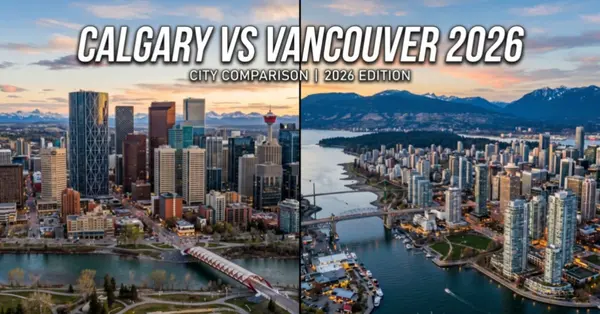
For a deeper breakdown of what your money goes toward month to month — including utilities, groceries, childcare, and transportation — see my Calgary cost of living guide. For a direct city comparison, see my Calgary vs Toronto 2026 guide and Calgary vs Vancouver 2026 guide. And when you're ready to start planning the move itself, my Calgary relocation hub has everything in one place.
The Job Market
Calgary's economy has diversified significantly over the last decade. Yes, energy is still foundational — but the city's tech sector, financial services industry, healthcare system, and construction market have all expanded meaningfully. Major employers include Enbridge, TC Energy, Suncor, Rogers, Telus, ATB Financial, Alberta Health Services, and a growing list of tech companies drawn by Alberta's competitive corporate tax environment.
The Lifestyle Argument
This one's harder to put a dollar figure on, but it's real. Calgary families regularly tell me — six months after their move — that they didn't expect to feel so much space. Space in their home, space in their neighbourhood, space on the weekends. The city has over 900 km of urban pathways. You can kayak on the Bow River in the summer and ski at Lake Louise 90 minutes away in the winter. The Calgary Stampede in July brings the entire city together in a way that's genuinely hard to describe until you've experienced it.
Understanding Calgary's 8 MLS Zones (And What They Mean for Your Family)
Most people moving to Calgary hear about the four quadrants — NW, NE, SW, SE. But here's what real estate professionals actually use to navigate the city: the 8 CREB MLS zones. In 2016, the Calgary Real Estate Board redrew the map, subdividing the four quadrants into eight distinct districts that much more accurately reflect how Calgary's communities differ from one another in character, price, and lifestyle.
Think of the four quadrants as the big picture and the 8 MLS zones as the zoom-in. Each zone has its own personality, price range, school landscape, and lifestyle feel. For families relocating from Ontario or BC, this is the framework I walk every client through before we start looking at homes.
The eight zones are: City Centre, Northwest, North, Northeast, East, Southeast, South, and West.
For a deep-dive into specific communities within each zone — including school catchment areas, price trends, and lifestyle comparisons — see my full guide: Where to Live in Calgary: A Neighbourhood Guide for Families.
City Centre — Urban, Walkable, and More Varied Than You'd Expect
The City Centre MLS zone is Calgary's largest and most diverse district — and it's commonly misunderstood by people relocating from out of province. It isn't just downtown. It covers the entire inner city: the downtown core and Beltline at its heart, plus a wide ring of established inner-city communities stretching as far southwest as Killarney, as far southeast as Inglewood, and as far north as Highland Park.
North of the Bow River you'll find Hillhurst, West Hillhurst, and Sunnyside — collectively known as Kensington — plus Bridgeland, Renfrew, Crescent Heights, and Capitol Hill. These are walkable, character-rich neighbourhoods with heritage homes, infills, and a genuinely local feel. Kensington Road and 1st Avenue NE in Bridgeland are lined with independent cafes, restaurants, and boutiques. These communities suit families and professionals who want urban life without the high-rise density of the Beltline.
South of the Bow River, the downtown core, Beltline, East Village, Mission, and Eau Claire anchor the zone. The Beltline — centred on 17th Avenue SW — is Calgary's most vibrant restaurant and nightlife corridor. East Village has transformed dramatically over the past decade into a modern urban neighbourhood anchored by the National Music Centre and the Central Library.
The inner-city south adds another layer entirely. Altadore, South Calgary, and the Marda Loop area attract young families who still want an inner-city lifestyle. Elbow Park, Britannia, Upper and Lower Mount Royal, and Rideau Park represent Calgary's most prestigious inner-city addresses. Inglewood, just east of downtown, is Calgary's oldest neighbourhood — artsy, independent, and increasingly sought-after.
- Best for: Urban professionals, couples, empty nesters, families wanting walkable inner-city living
- Property types: High-rise condos (downtown/Beltline), low-rise condos and apartments (Kensington, Bridgeland, Mission), character homes and modern infills (Hillhurst, Altadore, Elbow Park), luxury detached (Mount Royal, Britannia)
- Typical price range: $280,000 (entry-level apartment condos) to $3,000,000+ (prestige detached in Mount Royal)
- Transit: Best C-Train access in the city; free fare zone covers the entire downtown core
Browse live listings: City Centre Calgary homes for sale
Northwest — Established, Mountain-Close, and Family-Strong
The Northwest zone is the mountain-access corridor that draws outdoor families in large numbers. Tuscany, Royal Oak, and Arbour Lake sit here, all connected to downtown by the Red Line C-Train. The University of Calgary, Foothills Medical Centre, and Alberta Children's Hospital are also in this zone — making it a natural fit for healthcare workers, academics, and families who want mature community character with quick access to Banff and Kananaskis. Arbour Lake is Calgary's only NW lake community.
- Best for: Outdoor-oriented families, UCalgary and hospital staff, C-Train commuters, mountain lifestyle seekers
- Top communities: Tuscany, Rocky Ridge, Royal Oak, Arbour Lake, Varsity, Dalhousie, Silver Springs, Bowness, Brentwood
- Property types: Detached homes, duplexes, townhouses — mix of 1980s–2010s builds
- Typical price range: $550,000 – $950,000+
- Transit: Red Line C-Train runs from Tuscany through Crowfoot, Dalhousie, and into downtown
Browse live listings: Northwest Calgary homes for sale
North — New Construction, Growing Fast, Family-Focused
The North zone was carved out of what used to be split between the NW and NE quadrants, and the distinction matters. Communities like Evanston, Panorama Hills, Coventry Hills, Carrington, Livingston, and Glacier Ridge sit here — not in the Northwest or Northeast. This is one of Calgary's fastest-growing areas, driven almost entirely by new construction and young families. The tradeoff is that community infrastructure — schools, amenities, retail — is still catching up with the pace of development in some pockets.
- Best for: Families wanting new builds at accessible price points, buyers who prioritize square footage and modern layouts
- Top communities: Evanston, Panorama Hills, Coventry Hills, Carrington, Livingston, Sage Hill, Sherwood, Glacier Ridge, Ambleton
- Property types: New detached homes, duplexes, laned homes — primarily 2005–present builds
- Typical price range: $550,000 – $800,000 for detached homes
Browse live listings: North Calgary homes for sale
Northeast — Calgary's "Hail Alley" (Read This Before You Buy)
The Northeast zone is Calgary's most culturally diverse district and home to a large and vibrant South Asian, Middle Eastern, African, and Filipino community. The cultural amenities here — ethnic grocery stores, restaurants, places of worship, and community organizations — are genuinely excellent. Calgary International Airport is also in this zone, which is convenient for families who travel frequently.
But there is a serious financial issue with the Northeast that I have a responsibility to explain plainly before you consider buying here.
The Northeast sits in the heart of what insurers now call "Hail Alley."
The pattern of major hailstorms hitting this part of Calgary has been extraordinary in both frequency and severity. The June 2020 storm caused $1.2 billion in insured losses — primarily in the Northeast. The August 2024 storm caused $3.25 billion in insured losses and generated over 130,000 insurance claims in a single day — the costliest hailstorm in Canadian history. Hail-related insurance claims in Calgary have now exceeded $11 billion over the past two decades, with more than $6 billion occurring in just the last five years.
The insurance market has responded accordingly:
- Some insurers are declining to renew policies in Northeast postal codes entirely — particularly T3J and T3N
- Residents who can find coverage are reporting monthly premiums jumping from $180 to $580 per month or more
- Hail deductibles of $10,000 or higher are becoming standard in the zone
- Some homeowners have been unable to secure any coverage at all, creating mortgage renewal complications
My position on this has been consistent for years: I do not proactively recommend the Northeast zone to families relocating from Ontario or BC. A home that looks affordable based on its list price can become significantly more expensive to own when insurance premiums are two to three times the city average. If the Northeast is important to you because of community and cultural ties, I will absolutely help you buy there — and I will make sure you go in with eyes open. But I will not recommend it unprompted, and I will not understate the insurance issue to make a sale.
- Communities: Saddle Ridge, Taradale, Martindale, Falconridge, Castleridge, Redstone, Skyview Ranch, Cornerstone, Cityscape, Homestead
- Typical price range: $430,000 – $700,000 for detached homes
- Insurance warning: Obtain insurance quotes before making an offer — not after. Some postal codes are experiencing outright coverage denials from multiple providers.
East — Calgary's Most Affordable Detached Market (With an Important Caveat)
The East zone is the most affordable district in Calgary's MLS system — and that affordability is real and meaningful for buyers with tight budgets. But it comes with context I have a responsibility to share honestly.
The East zone consistently records some of the highest crime rates in the city. This isn't a blanket statement about every street or every block — crime in Calgary, like every city, is hyper-local. But as a zone-level pattern, the data is consistent enough that I don't recommend the East as a primary destination for families relocating from Ontario or BC who are unfamiliar with Calgary. There are better value propositions elsewhere in the city.
If affordability is your primary driver and the East zone price point is what's attracting you, compare it carefully against the North zone first. Communities like Evanston, Carrington, and Livingston offer new construction, modern infrastructure, and lower crime rates at price points only modestly higher — and the long-term value proposition is significantly stronger.
- Communities: Forest Lawn, Albert Park / Radisson Heights, Southview, Dover, Penbrooke Meadows, Erin Woods, Monterey Park
- Property types: Older detached homes, bungalows, duplexes — primarily 1960s–1980s builds
- Typical price range: $380,000 – $550,000 for detached homes
Southeast — Lake Communities, Master-Planned, and Top-Ranked for Families
The Southeast zone is the one I show most often to families relocating from Ontario and BC — and for good reason. This is Calgary's fastest-growing district, home to the city's most celebrated lake communities. Mahogany, Auburn Bay, and McKenzie Lake give families private lake access, HOA-managed amenities, excellent schools, and modern infrastructure. Cranston's Riverstone development, backing onto the Bow River and Fish Creek Provincial Park, is one of the most scenic addresses in the entire city.
- Best for: Young families wanting master-planned communities, lake lifestyle, modern schools, and full suburban amenities
- Top communities: Mahogany, Auburn Bay, Cranston, McKenzie Lake, Copperfield, New Brighton, Quarry Park, Hotchkiss, Seton
- Property types: Detached homes, duplexes, townhouses — mix of 2000s builds and active new construction
- Typical price range: $500,000 – $950,000 for detached homes
Browse live listings: Southeast Calgary homes for sale
South — Tight-Knit, Established, and Park-Rich
The South zone is what many Calgarians still call the "Southwest" — and it punches above its weight for family liveability. Fish Creek Provincial Park anchors the southern edge. Neighbourhoods like Evergreen, Shawnessy, Millrise, and Legacy offer strong schools, established community infrastructure, and quick access to both Bragg Creek and Kananaskis.
- Best for: Families wanting established communities with park access, buyers seeking more land for their dollar
- Top communities: Evergreen, Shawnessy, Millrise, Midnapore, Legacy, Pine Creek, Silverado, Sundance
- Property types: Detached homes, townhouses — largely 1990s–2010s builds with newer communities on the southern edge
- Typical price range: $550,000 – $850,000 for detached homes
Browse live listings: South Calgary homes for sale
West — Private Schools, Mountain Views, and Premium Living
The West zone is one of Calgary's most desirable districts for established families and move-up buyers. It's home to a remarkable concentration of private schools — Rundle College, Calgary Academy, Webber Academy, Calgary French & International School, and others — making it a natural draw for families where education choice is a priority. Aspen Woods, Springbank Hill, West Springs, Cougar Ridge, and Garrison Green define the character of this zone: large lots, mountain-view streets, and some of the quickest access to the Rockies in the entire city.
- Best for: Established and move-up families, buyers prioritizing private school access, outdoor and mountain lifestyle seekers
- Top communities: Aspen Woods, Springbank Hill, West Springs, Cougar Ridge, Garrison Green, Currie Barracks, Discovery Ridge, Signal Hill
- Property types: Detached homes, semi-detached, infills — mix of 2000s–2020s builds
- Typical price range: $700,000 – $2,000,000+
- Transit: West LRT (69th Street Station) provides C-Train access for commuters
Browse live listings: West Calgary homes for sale
The MLS zone map is a starting point, not a finish line. I've watched families fall in love with zones they never expected — and walk away from zones they were certain about. Every zone has communities inside it with wildly different feels, price points, and school catchments. My YouTube channel has community video tours for every major zone in Calgary — filmed from the ground and sometimes from the air with my drone — so you can get a real sense of each area before you ever book a flight. And when you're ready to narrow it down, that conversation is always free.
Cost of Living: What You Can Actually Afford in Calgary
One of the most common questions I hear from families in Ontario and BC is: "How much cheaper is Calgary really?" The honest answer: significantly cheaper — but not in every category. Here's a practical snapshot.
Housing (April 2026 Benchmarks)
| Property Type | Calgary Price Range |
|---|---|
| Benchmark home (all types) | ~$565,600 |
| Detached home (average) | ~$700,000–$750,000 |
| Semi-detached / duplex | ~$600,000–$660,000 |
| Townhouse | ~$400,000–$500,000 |
| Apartment condo | ~$280,000–$350,000 |
| 1-bedroom rental | ~$1,500–$1,700/month |
| 2-bedroom rental | ~$1,800–$2,100/month |
Monthly Household Snapshot
| Expense | Monthly Estimate |
|---|---|
| Groceries (family of 4) | $800–$1,100 |
| Utilities — apartment | $150–$250 |
| Utilities — detached home | $280–$470 |
| Internet | $75–$100 |
| Mobile phone (unlimited) | $60–$100 |
| Car insurance | ~$125–$200 |
| Childcare / daycare (licensed $15/day program) | $326.25/month (full-time) |
| C-Train monthly pass (adult) | ~$126/month or $4/ride |
| Home insurance | ~$125–$250 |
For a full side-by-side comparison of Calgary versus Toronto and Vancouver costs — including the Alberta tax advantage in detail — see my Calgary cost of living guide. And for current market prices, see my Calgary house prices April 2026 update.
The Alberta Tax Advantage
No PST. No land transfer tax on home purchases. Alberta's personal income tax rates are among the lowest in Canada. For a household spending $60,000 per year on taxable goods and services, the difference between Alberta's 5% GST and Ontario's 13% HST is roughly $4,800 annually — just from everyday spending. That's a car payment. A vacation. A significant RRSP contribution.
Calgary Schools: Your Kids Are in Good Hands
Families relocating from Ontario and BC consistently tell me they're impressed by the variety and quality of Calgary's school system. You have more choice here than almost anywhere in Canada.
Calgary Board of Education (CBE) — Public Schools
The CBE operates over 240 schools across the city. Programs available at the public level include French Immersion (from kindergarten), International Baccalaureate (IB) Middle Years and Diploma programs, Advanced Placement (AP), science and arts-focused specialty programs, and Indigenous language programs. School registration is community-based — your home address determines your designated school. Before finalizing a neighbourhood, use the CBE school locator to confirm catchment boundaries.
Calgary Catholic School District (CCSD)
If faith-based education matters to your family, the CCSD operates 118 schools across Calgary and offers French Immersion from early grades. Enrollment is open to all families, though Catholics receive priority in oversubscribed schools. Find your school at cssd.ab.ca/schools.
Charter & Private Schools
Calgary's private and charter school landscape is strong. Notable options include Calgary French & International School, Webber Academy, Clear Water Academy, Master's Academy, Rundle College, West Island College, and Foundations for the Future Charter Academy. Private school fees typically range from $8,000 to $30,000+ per year.
Post-Secondary Education
- University of Calgary (UCalgary): Major research university in the NW — law, medicine, engineering, business
- Mount Royal University (MRU): Bachelor degrees and professional programs in the SW
- SAIT: One of Canada's top technical institutes — trades, technology, hospitality, business
- Bow Valley College: Downtown Calgary — adult upgrading, business, health, social services
School Enrollment Tip: In Calgary, school enrollment is community-based. Contact your designated CBE or CCSD school as early as possible — ideally before your move. French Immersion programs often have waitlists, so apply early. Bring your child's immunization records, last report card, and proof of your Calgary address.
For a complete breakdown of every school type — public CBE, Catholic CCSD, charter schools, and private options from kindergarten through grade 12 — see my Calgary schools guide.
The Calgary Weather Truth (Including the Part About Chinooks)
Calgary winters are real. If you're moving from the Lower Mainland or Southern Ontario, you will experience a genuine cold-weather adjustment. The city averages 126 cm of snow annually and temperatures can drop to -25°C to -30°C. But here's what Calgary's weather story doesn't get enough credit for — and it's what makes it genuinely different from Edmonton or Winnipeg.
The Chinook Effect
Calgary is unique among Canadian prairie cities because of Chinook winds — warm, dry winds that blow in from the Rocky Mountains and can raise temperatures 15–20°C within hours. A -20°C morning can become a +10°C afternoon. Locals have learned to read the Chinook arch cloud on the western horizon like a promise. These winds don't just offer psychological relief — they reduce heating costs and keep the city from feeling trapped in the prolonged deep freezes that other prairie cities deal with.
Calgary's Climate at a Glance
| Season / Metric | What to Expect |
|---|---|
| Annual sunshine hours | 2,400+ — sunniest major city in Canada |
| Summer highs | 25–28°C; occasional heat waves to 33–35°C |
| Winter lows | Can reach -25°C to -30°C; average -10°C to -15°C |
| Snow season | October through April |
| Annual precipitation | ~400 mm — one of Canada's driest major cities |
| Spring | Short and unpredictable — snow in April is common; flowers by May |
| Autumn | Crisp and colourful — genuinely one of Calgary's best seasons |
What You'll Need for Winter
- Winter tires (budget $800–$1,200 for a quality set)
- Heavy winter jacket rated to -30°C
- Waterproof insulated boots
- Balaclava, thermal underlayers, insulated gloves
- Block heater for your vehicle (pre-installed in many Alberta-purchased used vehicles)
- Snow shovel and ice scraper
- Emergency kit in your vehicle (blanket, candles, sand, booster cables)
Healthcare, Transit, and Day-to-Day Life in Calgary
Healthcare
Calgary has a comprehensive hospital network. Major facilities include Foothills Medical Centre (Calgary's largest hospital and major trauma centre, NW), Alberta Children's Hospital (dedicated pediatric care, NW), Rockyview General Hospital (SW), South Health Campus (SE — serving the fast-growing south end), and Peter Lougheed Centre (NE).
Finding a family doctor: Start this before your move. Use albertafindadoctor.ca. Family doctor availability varies by community — this matters when you're choosing a neighbourhood.
Getting Around Calgary
Calgary is primarily a car-dependent city, particularly in the suburbs. That said, the C-Train (LRT) makes transit viable if you live near a line:
- Red Line: Connects NW communities (Tuscany) through downtown and southeast
- Blue Line: Serves the NE and SE, including the airport area
- Monthly adult pass: ~$126
- Downtown core: Free C-Train zone
- Future Green Line LRT: Breaking ground in 2025, will significantly improve SE transit connectivity
Calgary's ring roads — Stoney Trail and Deerfoot Trail — make cross-quadrant travel efficient by car. The city's 900+ km pathway system is genuinely world-class for cyclists and runners.
Shopping, Groceries, and Everyday Life
Major grocery chains include Safeway, Sobeys, Save-On-Foods, Real Canadian Superstore, and Co-op. Budget options include No Frills, Walmart Supercentre, and Giant Tiger. If you're coming from a diverse food background, the NE has exceptional specialty and ethnic grocers — T&T Supermarket, Persian markets, South Asian grocers. Major malls include Chinook Centre (SW), Market Mall (NW), CrossIron Mills (north of city), and Sunridge Mall (NE).
Calgary's Culture and Identity
This city punches well above its weight for a population of 1.6 million. The Calgary Stampede in July is unlike anything else in Canada — 10 days of rodeo, concerts, community pancake breakfasts, and pure Western Canadian identity. Over 1.47 million people attend annually. Beyond Stampede, you have the Calgary Philharmonic Orchestra, Theatre Calgary, the National Music Centre, and the Glenbow Museum. The Flames (NHL), Stampeders (CFL), and Cavalry FC (soccer) give you professional sport year-round.
Your Moving to Calgary Timeline: 6 Months to Move Day
The families who have the smoothest moves start planning six months out. The ones who struggle started six weeks out. Here's your roadmap.
6 Months Before Move Day
- Research Calgary neighbourhoods and narrow down your target zone and communities
- Begin mortgage pre-approval conversations with a broker
- Contact a Calgary real estate agent — critical for remote buyers who need virtual showings, neighbourhood videos, and local due diligence
- Begin decluttering — sell, donate, or discard anything you won't move
- Research long-distance moving companies and request a minimum of three quotes
- If you have school-age children, research Calgary school enrollment timelines now
3–4 Months Before Move Day
- Finalize your Calgary home purchase or rental agreement
- Book your long-distance moving company — top companies fill fast in spring and summer
- Notify your current landlord of your move-out date per lease terms
- Gather and organize all critical documents (see the legal section below)
- Research and select Calgary internet and utility providers
- Notify children's schools of withdrawal date and request records transfer
1–2 Months Before Move Day
- Confirm moving company booking in writing
- Complete your moving inventory — photograph every room before packing
- Arrange travel for family and pets
- Set up utilities at your new Calgary address — activation date = your move-in date
- Set up Canada Post mail forwarding at canadapost.ca
- Notify banks, insurance companies, and financial institutions of address change
2 Weeks Before Move Day
- Confirm moving company arrival time and final cost details
- Pack your "Open Me First" essentials kit (see the settling section below)
- Cancel or transfer local memberships, gym passes, and library cards
- Photograph your current home's condition — critical for renter deposit recovery
Move Day
- Be present for movers' arrival and do a walkthrough with the foreman
- Keep your essentials kit, valuables, and documents with you — not on the truck
- Do a final walkthrough of your old home before handing over keys
Choosing a Moving Company
Long-distance moves from Ontario or BC to Calgary are significant undertakings. Protect yourself by confirming: licensed and insured for inter-provincial moves; written binding estimates (not phone quotes that change at delivery); clear insurance coverage options; and positive reviews on Google, HomeStars, and the Better Business Bureau. PODS and portable container services (U-Pack, 1-800-PACK-RAT) offer a flexible alternative — particularly useful when your Calgary closing date doesn't align perfectly with your move-out date.
Alberta Utilities: What's Different Here
Alberta operates a deregulated energy market — you choose your own electricity and natural gas provider. This is different from most provinces. Before connecting, compare rates at ucahelps.alberta.ca (Utilities Consumer Advocate). For internet, the main providers are Rogers/Shaw, Telus, TekSavvy, and Oxio.
Alberta Legal & Administrative Checklist
Moving between provinces is a legal and administrative transition, not just a physical one. Here's what you need to action and when.
Key Alberta Deadlines
| Deadline | Task |
|---|---|
| Within 3 months of arrival | Apply for Alberta Health Care Insurance Plan (AHCIP) |
| Within 90 days of arrival | Exchange out-of-province driver's licence for an Alberta licence |
| Within 90 days of arrival | Register your vehicle in Alberta |
| Immediately upon arrival | Update vehicle insurance to reflect your Alberta address |
| As soon as possible | Set up Canada Post mail forwarding |
| As soon as possible | Update your CRA address via My Account at canada.ca/cra |
| Before first school day | Enroll children with immunization records, last report card, proof of address |
| Tax time | Claim eligible moving expenses on Form T1-M if you moved 40+ km closer to work |
Alberta Health Care: The 3-Month Wait
This catches many newcomers off guard. When you register for the Alberta Health Care Insurance Plan (AHCIP), coverage begins on the first day of the third month following the date you establish residency. If you arrive July 12, coverage starts October 1. During the gap, your previous province's health card may provide some emergency coverage, but it's wise to purchase private bridge coverage (~$3–$10/day) to fill the gap. Apply at any authorized Alberta Registry Agent office — bring government-issued photo ID, proof of Alberta address, and your SIN card.
Documents to Keep With You (Not on the Truck)
- Passports and birth certificates for all family members
- SIN cards or letters
- Current driver's licences and health cards
- Marriage certificate, divorce decree, or custody agreements (if applicable)
- Immigration documents (if applicable)
- Will and power of attorney documents
- Complete medical records for all family members (request from your doctor before leaving)
- Children's immunization records and school transcripts
- Last 2 years of CRA Notice of Assessment (needed for mortgage applications)
- Vehicle registration and insurance documents
Moving Expense Tax Deductions
If you're moving at least 40 km closer to a new place of work or school, you may be able to deduct eligible moving expenses on your federal tax return (Form T1-M). Eligible expenses can include transportation and storage of household goods, travel costs including meals and accommodation en route, temporary living costs near your new home (up to 15 days), and real estate commissions if you were selling your old home. Consult a tax professional for your specific situation.
Relocation Budget: What to Plan For
- Professional moving company (Ontario to Calgary): $4,000–$12,000
- PODS / container service: $2,500–$6,000
- First & last month's rent (if renting): $3,200–$5,000
- Winter tires (if not already owned): $900–$1,200
- Legal/notary fees (if purchasing): $1,200–$2,500
- Home inspection (if purchasing): $400–$700
- Land transfer tax (Alberta): $0
- Estimated total for a renting family from Ontario: $10,000–$20,000
- Estimated total for a purchasing family from Ontario: $18,000–$35,000+
Your First 30 Days in Calgary
The truck has arrived. The boxes are everywhere. The kids are tired and someone can't find the kettle. This is completely normal. Here's how to make the first month work.
Your "Open Me First" Kit
Pack one clearly labeled box or duffel bag that travels with you — not on the moving truck. It should include: toilet paper, paper towels and cleaning wipes, dish soap, toothbrushes and toothpaste for everyone, soap and shampoo, one change of clothes per person, bedding or sleeping bags, all phone chargers, a flashlight and batteries, a basic tool kit, a kettle or coffee maker, disposable plates and utensils for Day 1, pet food and a water bowl, all prescription medications, and a written list of important contacts and account numbers. This kit is your sanity for the first 24–48 hours.
Change of Address: The Master List
Set up Canada Post mail forwarding first at canadapost.ca, then work through these systematically within your first 30 days:
- Government: CRA (canada.ca/cra), Service Canada, Elections Canada, provincial licensing boards for any regulated professions
- Financial: All bank accounts, credit cards, RRSP/TFSA/RESP accounts, investment accounts, mortgage lender, life and disability insurance, employer benefits
- Insurance: Cancel old home or tenant insurance and activate new Calgary policy; update vehicle insurance address immediately
- Personal: Amazon and online shopping accounts, subscription boxes, loyalty programs (Air Miles, PC Optimum, Aeroplan, Costco), employer HR records
Building Your Calgary Community
This is the part families worry about most — and the part that usually surprises them most positively. Calgarians are genuinely friendly. The city's community association system makes connecting easier than almost anywhere I know.
Calgary has over 200 community associations — volunteer-run organizations that operate community halls, skating rinks, and neighbourhood programs. Joining your local community association is one of the best investments you can make in your social integration. Find yours at calgarycommunities.com.
Other strong connectors: your children's school community (the fastest social connector for families with kids), minor sports leagues (Calgary has exceptional youth sports infrastructure), the "New to Calgary" Facebook group (very active newcomer community), and Nextdoor (widely used in Calgary neighbourhoods).
Children and the Adjustment Period
Moving is hard on kids. Even a move they're excited about brings anxiety. Before the move, involve them in the process — let them choose their room colour, research their new school, and plan video call schedules with friends. After the move, enroll in activities as early as possible — sports teams, art classes, and youth programs are where Calgary kids make friends. Give it time. Most children settle in within 3–6 months.
Pets in Calgary
Calgary is an exceptionally pet-friendly city. There are off-leash parks in almost every community and the pathway system is perfect for dogs. You'll need to register your dog with the City of Calgary (required annually — calgary.ca/pets). Find a Calgary vet before an emergency arises — ask neighbours for referrals when you arrive. Calgary has over 150 off-leash areas across the city.
Moving to Calgary FAQ
Is Calgary a good place to raise a family?
Yes — consistently. Calgary offers excellent schools, safe communities, strong family incomes, access to nature, and a genuine community culture that few Canadian cities can match at this price point. It regularly ranks among the top cities in Canada and globally for liveability.
Is it worth moving to Calgary from Toronto?
For most families, yes. The housing cost difference alone is often $400,000–$600,000 for a comparable home. Add the tax savings (no PST, no land transfer tax), the higher median incomes, and the quality of life factors, and the financial case is strong. The lifestyle is different — more outdoors-oriented, more suburban, different winters — but the vast majority of families who make the move don't regret it. For the full numbers, see my Calgary vs Toronto comparison.
Is moving from Vancouver to Calgary a good idea?
For many Vancouver families, moving to Calgary is one of the most financially transformative decisions they can make. The average detached home in Vancouver sells for well over $1.5 million — in Calgary, that same budget buys an exceptional home in a top family neighbourhood, often with money left over. Calgary offers no provincial income tax, more space, shorter commutes, and similar access to mountains and outdoor lifestyle. For the full comparison, see my Calgary vs Vancouver 2026 guide.
What is the best area to live in Calgary for families?
It depends on your priorities. The SE lake communities (Mahogany, Auburn Bay, Cranston) are the top choice for young families who want master-planned communities and modern infrastructure. The NW (Tuscany, Rocky Ridge) is excellent for outdoor-oriented families who want mountain access. For a full comparison, see my Where to Live in Calgary neighbourhood guide.
How much money do I need to move to Calgary?
A general planning estimate: $10,000–$20,000 for a renting family from Ontario (including moving costs, first and last month's rent, winter gear, administrative fees, and a buffer); $18,000–$35,000+ for a purchasing family. Your specific number depends on your origin city, family size, and housing choice.
Do I need winter tires in Calgary?
Yes — practically speaking, this is not optional. Calgary averages 126 cm of snow annually and temperatures that make all-season tires inadequate for safe winter driving. Budget $900–$1,200 for a quality set of winter tires.
How long does it take to get Alberta health care coverage?
Coverage begins on the first day of the third month after you establish Alberta residency. Register at an Alberta Registry Agent office as soon as you arrive, and consider private bridge coverage for the waiting period.
What is the cost of living in Calgary compared to Toronto?
Substantially lower, particularly for housing. A comparable home that costs $1.2M+ in Toronto averages ~$568,000–$700,000 in Calgary. Rental costs are 25–35% lower. No PST and no land transfer tax add thousands more in annual savings. Groceries and utilities are comparable.
Ready to Make Your Move? Let's Talk.
Moving to Calgary is one of the most significant decisions your family will make — and getting the neighbourhood right from the start makes everything else easier. I've been helping families find their Calgary fit for 35 years. I was born here, raised here, and my family is rooted here across three generations.
If you're relocating from Ontario or BC and want someone who knows every community deeply — I'd love to connect. Start with my Calgary relocation hub for a full overview of resources, or when you're ready to talk:
Book a free 30-minute relocation call and let's figure out where your family belongs in Calgary.
Welcome to Calgary. You're going to love it here.
Categories
Recent Posts